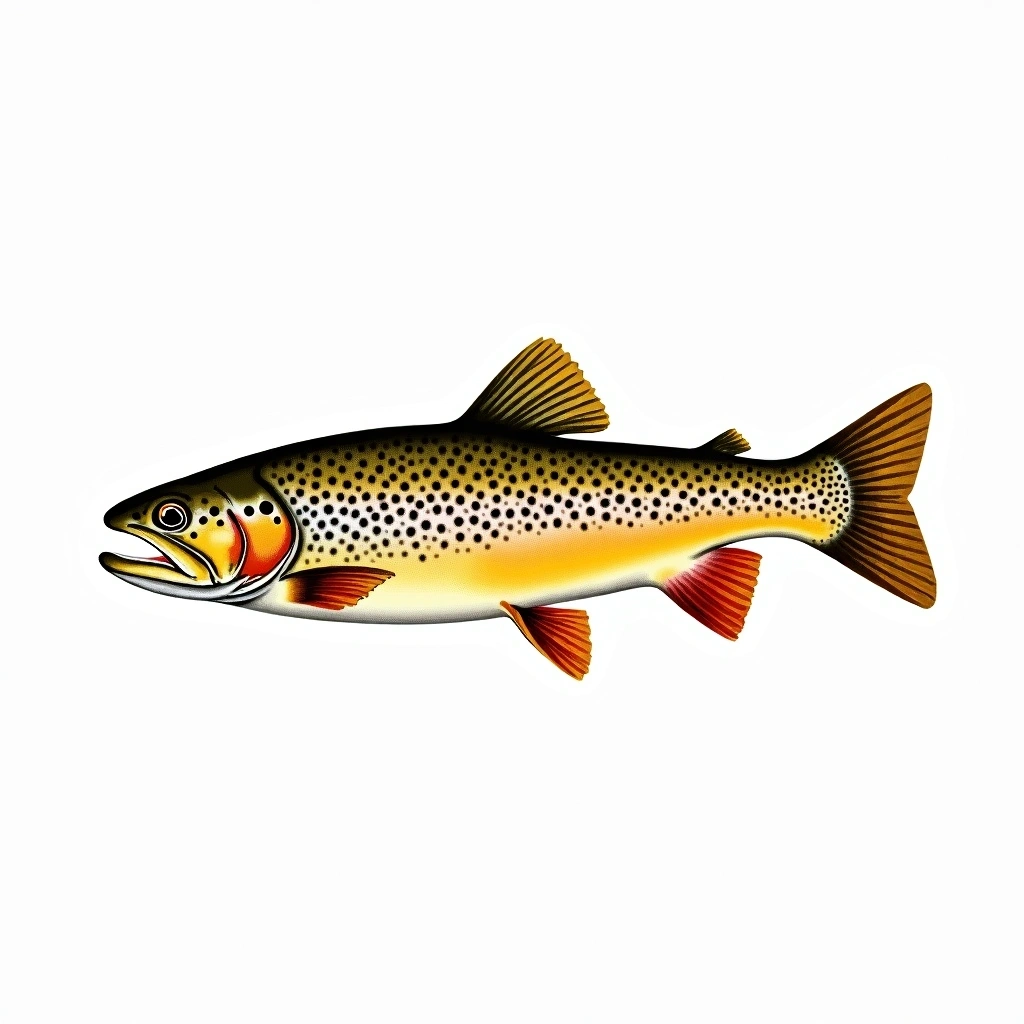
Truite de mer
Salmo trutta
Embed This Widget
Add the script tag and a data attribute to embed this widget.
<script src="https://cdn.jsdelivr.net/npm/fishfyi-embed@1/dist/embed.min.js" defer></script>
<div data-fishfyi="fish" data-slug="brown-trout"></div>Embed via iframe for maximum compatibility.
<iframe src="https://fishfyi.com/iframe/fish/brown-trout/" width="420" height="400" frameborder="0" style="border:0;border-radius:10px;max-width:100%" loading="lazy"></iframe>Paste this URL in WordPress, Medium, or any oEmbed-compatible platform.
https://fishfyi.com/fish/brown-trout/Add a dynamic SVG badge to your README or docs.
[](https://fishfyi.com/fish/brown-trout/)Use the native HTML custom element.
<script src="https://cdn.jsdelivr.net/npm/fishfyi-embed@1/dist/embed.min.js" defer></script>
<fishfyi-fish slug="brown-trout"></fishfyi-fish>Overview
Renowned for its wariness, the brown trout is a European and western Asian salmonid so cautious that large individuals turn nocturnal and shift to hunting smaller fish. Golden-brown flanks scattered with haloed black and orange-red spots distinguish it, while sea-run fish take on a silvery sheen. Native from Iceland and the British Isles through Scandinavia, the Alps, and the Caucasus, it favours clear, cool rivers and lakes over gravel and rock. Introduced across the globe, it has become a defining challenge for fly fishers wherever it swims. It reaches 1.4 metres, and its firm, cream-to-pink flesh is richer than that of rainbow trout, while the species is assessed as Least Concern.
On this page
À propos
The brown trout is native to European rivers and has been introduced worldwide. Renowned for its wariness and intelligence, it is the ultimate quarry for fly fishers. Larger specimens become nocturnal, feeding primarily on smaller fish.
Physical Description
| Measurement | Value |
|---|---|
| Maximum Length | 140,0 cm |
| Maximum Weight | 20,0 kg |
| Plage de profondeur | 0-28m |
Coloration
Golden-brown to amber flanks scattered with large black and orange-red spots, each often encircled by a pale halo; belly golden-yellow; adipose fin is orange-tinged; sea-run form is silvery.
Habitat & Distribution
Rivers, streams, and lakes across Europe, western Asia, and North Africa; widely introduced. Inhabits clear, cold to temperate rivers (8-18°C) over gravel and rock. Anadromous sea-run populations exist.
Aire de répartition
Native to Europe and western Asia from Iceland and the British Isles east through Scandinavia, the Alps, and the Caucasus. Anadromous sea trout migrate between Atlantic coastal waters and freshwater rivers.
Pays
Distribution Map
Conservation Status
Truite de mer is classified as Least Concern by the International Union for Conservation of Nature (IUCN).
Comestibilité et gastronomie
Informations sur la pêche
Taxonomy
| Ordre | Salmoniformes (Salmon and trout) |
| Famille | Salmonidae (Salmons and trouts) |
| Espèces | Salmo trutta |
Names in Other Languages
| Language | Name |
|---|---|
| French | Truite de mer |
| Spanish | Trucha marina |
Foire aux questions
Can you eat Truite de mer?
How big does Truite de mer get?
Where is Truite de mer found?
Is Truite de mer endangered?
What family does Truite de mer belong to?
Similar Fish
Other species in the Salmonidae family
External Databases
Explore More
Fish Rankings
Discover the largest, heaviest, and most exciting fish species
Nature FYI Family
Explore more wildlife and biodiversity encyclopedias